
What if Europe had a public-service social network, based on principles similar to those behind public-service media? Would that help stop fake news spreading, people becoming trapped in information bubbles, and algorithms constantly trying to sell us ideas — and things — we may neither want nor need?
This is the question behind the European citizens’ initiative European Public Social Network. Its organisers, František Tichý and Lukáš Mikulecký, came independently to a similar idea: social media have become an essential part of public life, but the platforms where much of that public life now takes place are largely driven by commercial interests.
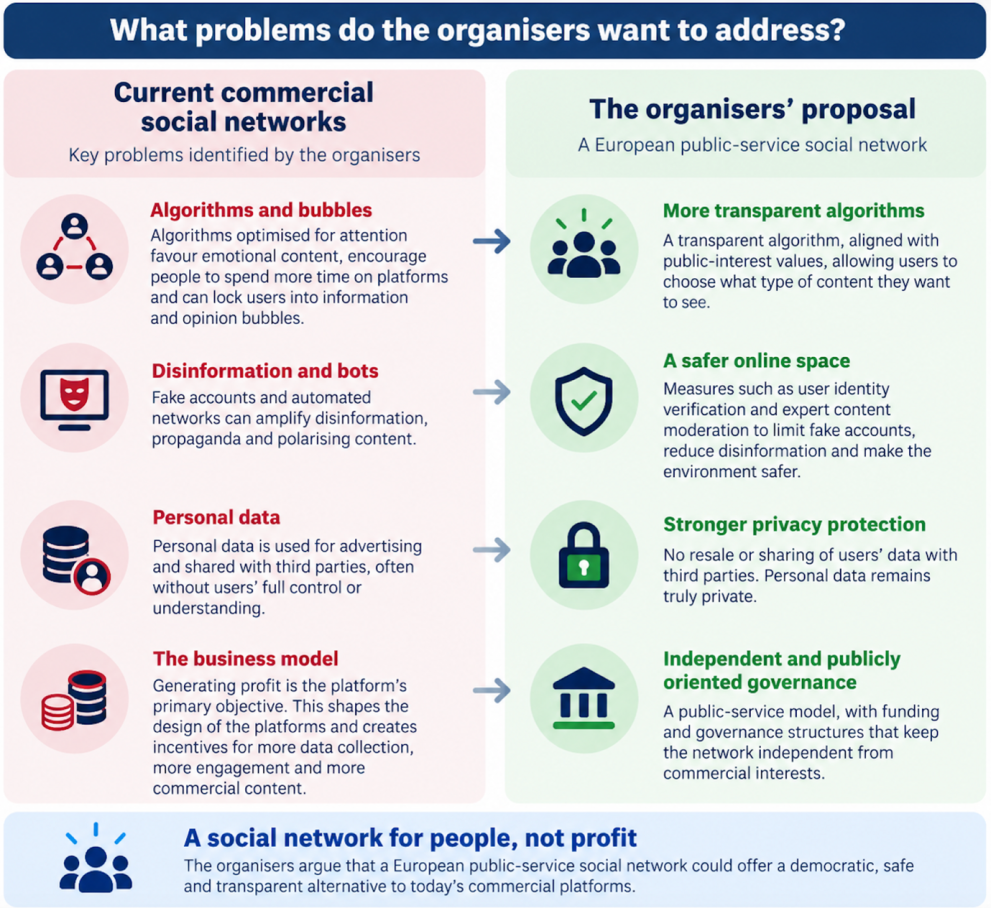
Their proposal takes inspiration from a model familiar across Europe: public-service media. The idea is not to create an EU-controlled social network, but an independent, publicly oriented alternative whose primary purpose would be communication and access to information rather than maximising engagement and profit.
And this distinction matters to the organisers. They support efforts to regulate existing platforms, tackle disinformation and make the online environment safer. But they argue that regulation alone cannot solve a problem rooted in the platforms’ underlying business model.

For František, the business model of today’s platforms is at the heart of the problem:
Lukáš approaches the same issue from another angle. Fact-checking and regulation are important, he says, but largely deal with the consequences of the system:
A great idea is not enough: when the Commission asks for a rethink
Before Lukáš and František could start thinking about collecting one million signatures, they encountered their first practical lesson in turning an idea into a European citizens’ initiative.
When they first submitted European Public Social Network for registration in December 2025, the European Commission found one fundamental problem: as originally worded, the initiative did not actually ask the Commission to propose an EU legal act.
- Check out the conditions for registration here.
- Find out How to draft an initiative: legal requirements and practical advice
- Still not sure? Ask an Expert.
This, however, did not mean that the initiative was rejected. At this stage of the registration process, the organisers had the option to revise their proposal in response to the Commission’s assessment, keep the original version, or withdraw it.
They chose to stay with the idea and revise the text.
Lukáš recalls:
The organisers then brought in legal expertise from several directions. They consulted experts from academia, particularly in European law, and discussed the formulation with former European Commission Vice-President Věra Jourová.
They also used the ECI Forum’s free Ask an Expert service. This was particularly important for an initiative which, according to František, has so far operated without external funding.
“At the very beginning, there were just the two of us.” Now the team has around 45 people
The second challenge was just as fundamental. A European citizens’ initiative needs to become European not only in the issue it addresses. It needs people and support across Member States.
European Public Social Network did not start as a project backed by a large European organisation. At the beginning, there were just two people in Czechia.
Lukáš says:
They looked for contacts through universities, colleagues and people with experience of Erasmus and other international programmes. And they were not simply looking for people to formally complete the group of organisers, but for anyone who felt strongly about the issue.
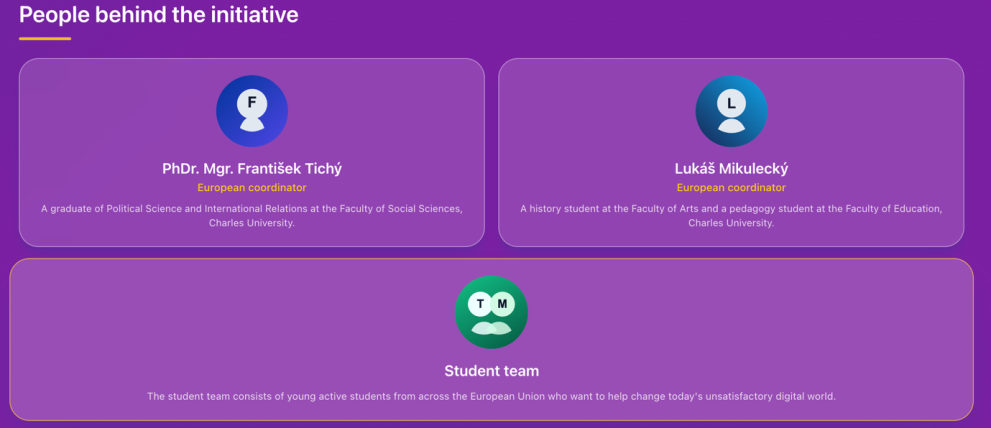
Through this process, the original pair gradually grew into a team of around 45 people from 11 EU Member States. The team continues to look for new members and others willing to help spread the initiative.
For František, it is important that they are all volunteers:
Their experience points to one possible way of turning an idea that was initially born in one Member state into a European project: rather than starting by looking for large institutions, start with people who can gradually open up new networks and new countries.
Forty-five volunteers are not enough. They need to become a team
As the number of volunteers grew, another question emerged: how do you coordinate dozens of people in different countries and turn support for an idea into a functioning European campaign?
The team divided itself into working groups covering areas such as PR, IT, events and HR. Alongside these, a country-based structure is being developed to help coordinate signature collection.
František explains how they divide the work:
For Lukáš, volunteering should not be a one-way relationship. Working on the campaign should also give people something in return:
And how do they plan to collect one million signatures?
Their emerging strategy has three main pillars.
The first is universities and student networks — the same environment that has already helped them build a European team. They plan to approach universities, student organisations and students themselves, who can help spread the initiative further.
They are also looking at what they can learn from other European citizens’ initiatives. František points to Stop Destroying Videogames, another initiative that had a strong presence in Czechia and grew from a small, student-led volunteer effort into a European campaign that collected more than one million signatures.
How the ‘Stop Destroying Videogames’ ECI went viral — and what you can learn from it
There are obvious parallels. Both started with young people and volunteers rather than large established organisations, and both address technology-related issues of particular importance to younger generations. But the communities around the two initiatives are different. Stop Destroying Videogames was able to mobilise an existing gaming community, including through Discord. European Public Social Network needs to find the networks that can play that role for its own campaign.
The lesson is not to copy another successful ECI’s communication channels, but to understand why those channels worked and identify the communities that can play the same role for a different cause.
The second pillar is PR and communication through social media. The aim is not simply to promote the call to sign, but to explain what the organisers see as the problems of the current social media model and encourage a wider public debate.
Lukáš explains:
The third pillar is events and face-to-face contact — debates, information stands and a planned small conference.
Using social media to change social media
And then there is the paradox that European Public Social Network cannot avoid.
If the initiative wants to convince one million Europeans that today’s model of social media needs an alternative, it first has to find those people.
And that means using the very social media platforms it wants to change.
František is pragmatic about this: despite their concerns about the way existing platforms operate, social media remain essential for reaching large numbers of people.
That is the paradox at the heart of their campaign — and it brings the story back to the question with which their initiative began.
Can they use the system they want to change to build a European movement for an alternative?
Lukáš Mikulecký, František Tichý and their 45 volunteers now have a year — and one million signatures — to find out.
You might be interested to read also:
- Webinar summary and recording: Understanding the legal requirements for launching an ECI
- How to structure your ECI team
- The volunteer-first strategy behind the Star-Pass ECI
The opinions expressed on the ECI Forum reflect solely the point of view of their authors and can in no way be taken to reflect the position of the European Commission or of the European Union.

Leave a comment