
Across Europe, active citizens, students, workers, and neighbourhood activists are already pushing for fairer, healthier, and more sustainable communities — often without realising that the causes they champion locally could grow into Europe-wide campaigns. The European Citizens’ Initiative (ECI) offers them a clear path to scale their ideas from local impact to EU-level policy change.
Local action and its European potential
Somewhere in Europe, a student is pushing for better mental health resources and support for youth, a union worker is campaigning for paid sick leave for part-time workers in their region, and one person is organising protests for better recycling facilities in a local neighbourhood. Europe’s next big campaigners are already out there. They might just not know it yet.
These local campaigns can have a European impact more than you might believe, beyond the immediate communities. Many of the issues being addressed, whether student well-being, fair labour conditions, or environmental protection, are areas where the European Union (EU) can act and lead. Topics and issues that originate locally can influence European policies. For example, a workplace can impact social or labour rights. A beach cleanup or a neighbourhood park can impact European approach to sustainability. These issues transcend borders and resonate across the continent. All that is missing are the right tools and support, with which these initiatives could grow into Europe-wide campaigns that mobilize citizens across Europe and shape legislation.

Photo by Tommaso Pecchioli / Pexels (Source: https://www.pexels.com/photo/people-holding-flags-11636475/)
European citizens’ initiatives (ECIs) as platforms
This is where the European citizens’ initiative (ECI) comes in. As Europe’s and the world’s only transnational tool of participatory democracy, it gives citizens a clear way to mobilise from the ground up around the issues that matter to them. Gathering one million signatures and building a civic movement becomes the driving force that gives visibility and weight to a wider advocacy campaign.
Clear trends from local to national to European
To gain a better understanding of the topics being addressed through petitions and citizens’ initiatives at local and national level, and therefore possible trends for the ECI, Democracy International carried out research in five EU countries and at the European Parliament petitions level and mapped popular petitions. Many address topics on which the EU can act. The organisers range from NGOs and grassroots coalitions to individual activists shaking up their local communities.
The trends are clear. Health, environmental protection, animal welfare, and social and economic rights, are amongst the most common topics raised, which happen to align perfectly with where the EU has competence to act.
Unsurprisingly, many of these local campaigns already echo issues from past ECIs. These grassroots efforts are not just local stories, but they have the potential to be the next ECI that actually influences European policy.
From the Bavarian fields to Brussels - the story of Save bees and farmers
What began in 2019 as a small local campaign in Bavaria, led by a handful of beekeepers and concerned farmers, has grown into one of Europe’s most visible environmental mobilisations. The first goal was simple and urgent: protect pollinators from harmful pesticides and support farmers to shift toward agroecological practices. The campaign built on the success of Bavaria’s Rettet die Bienen (“Save the Bees”) referendum, which gathered 1.7 million signatures and became the most successful state-level petition in German history. It was initiated by the Ecological Democratic Party (ÖDP) together with the Bavarian Bird Protection Society (LBV), BUND Naturschutz Bayern (Friends of the Earth Germany’s Bavarian branch), and the Umweltinstitut München, an environmental research and advocacy institute.
Following the referendum’s success, these groups helped inspire a wider European alliance. The same networks, together with partners from other Member States, worked with PAN Europe, an expert and activist group, to launch the Save Bees and Farmers European Citizens’ Initiative, uniting environmental NGOs, scientists, and farming communities across Europe under a common goal.
As an ECI, Save Bees and Farmers went through the full process. Signatures were verified, organisers presented their case in a public hearing at the European Parliament, and the European Commission issued a formal reply referencing ongoing and planned measures on biodiversity restoration and pesticide reduction. The campaign maintained strong public pressure during legislative debates, and in June 2024 the EU formally adopted the Nature Restoration Regulation, a flagship law to restore degraded ecosystems. Work on pesticide reduction remains contentious, but the initiative helped place binding reduction targets and pollinator protection firmly on the EU agenda.
The movement continues to grow, linking farmers, scientists, and environmental NGOs across Member States and tracking pesticide files with a view to long-term targets up to 2035. The conversation is widening too. This autumn, the European Commission hosted its first Young Citizens Assembly on Pollinators, bringing together one hundred randomly selected young people to discuss future solutions.
Through cross-border organising and consistent advocacy, Save Bees and Farmers shows how local activism can evolve into a European force that shapes legislation, influences public debate, and keeps biodiversity protection at the heart of EU policy.
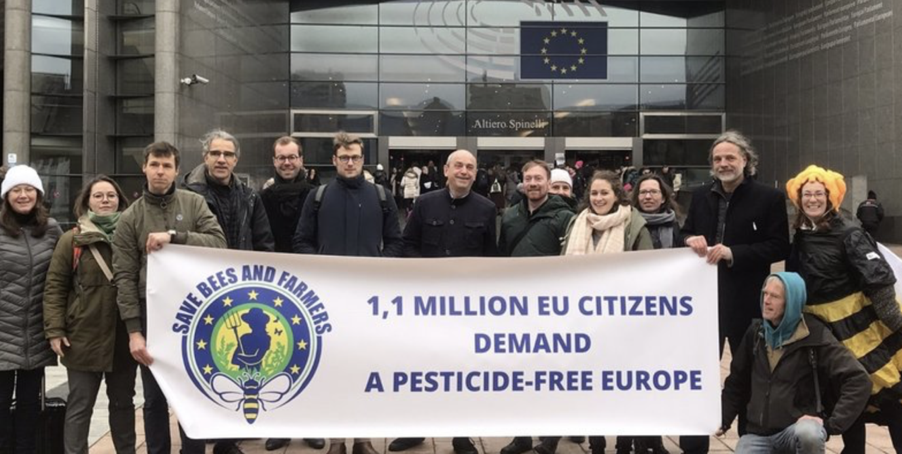
Photo: Save Bees and Farmers / European Citizens’ Initiative, Brussels (2023)
In 2023, a group of Latvian women’s rights advocates launched a petition with a simple but transformative goal: to make menstrual hygiene products freely available in schools. Initiated by the Women’s NGOs Cooperation Network (Sieviešu sadarbības tīkls), the campaign aimed to ensure that no girl or young woman would have to miss school because she couldn’t afford basic hygiene products.
What began as a local effort to restore dignity and equality soon gained national attention, collecting over 12,000 signatures and moving the Latvian Parliament to take the proposal under official analysis. The campaign successfully pushed the government to require schools to provide free menstrual hygiene products, marking a major step forward for gender equality and health rights in Latvia. It reframed period poverty as a question of fundamental rights rather than charity, showing how community-led initiatives can turn everyday inequalities into structural change.
From period poverty to policy change - Latvia’s fight for menstrual equity
In 2023, a group of Latvian women’s rights advocates launched a petition with a simple but transformative goal: to make menstrual hygiene products freely available in schools. Initiated by the Women’s NGOs Cooperation Network (Sieviešu sadarbības tīkls), the campaign aimed to ensure that no girl or young woman would have to miss school because she couldn’t afford basic hygiene products.
What began as a local effort to restore dignity and equality soon gained national attention, collecting over 12,000 signatures and moving the Latvian Parliament to take the proposal under official analysis. The campaign successfully pushed the government to require schools to provide free menstrual hygiene products, marking a major step forward for gender equality and health rights in Latvia. It reframed period poverty as a question of fundamental rights rather than charity, showing how community-led initiatives can turn everyday inequalities into structural change.
Much like the successful ECI My Voice, My Choice, which grew from a small cross-border campaign into a Europe-wide movement for reproductive rights, the Latvian initiative demonstrates that bodily autonomy and equality are deeply interconnected issues across Europe. Whether the focus is on access to abortion or access to menstrual care, these movements share a common message: true gender equality begins when no one’s body becomes a barrier to their rights or participation in society.
Could the last regional petition you signed be the next ECI?
Our sense of belonging begins locally, in the places where we grow up, study, and live. These familiar environments shape how we see the world and what we care about most. It is often within these local contexts that we first recognise problems and begin to act, whether by starting petitions, joining associations, or organising neighbourhood campaigns. This is how civil society takes shape and where the energy for collective change comes from. Yet many of these same issues extend far beyond the local level. Concerns about education, equality, and the environment connect people across Europe, revealing how closely our personal identities and European realities are linked.
The European Citizens’ Initiative builds on this connection by turning local action into European impact. Through the ECI Forum, citizens can find the tools, advice, and practical support to take their causes further, transforming small community efforts into campaigns that influence policy across the European Union. Every European movement begins with people who care about what happens in their own communities, and sometimes, that is exactly where the next big idea for Europe is already taking shape.

About the author:
Maya Kaufmann is the European Intern at Democracy International where she supports projects on citizen participation and European democracy. She has experience in research and communications on EU civic engagement and political communication. She holds a Bachelor of Science in International Relations and Organisations from Leiden University, where she specialised in Disinformation and Strategic Communication in Global Media.
The opinions expressed on the ECI Forum reflect solely the point of view of their authors and can in no way be taken to reflect the position of the European Commission or of the European Union.

Leave a comment