
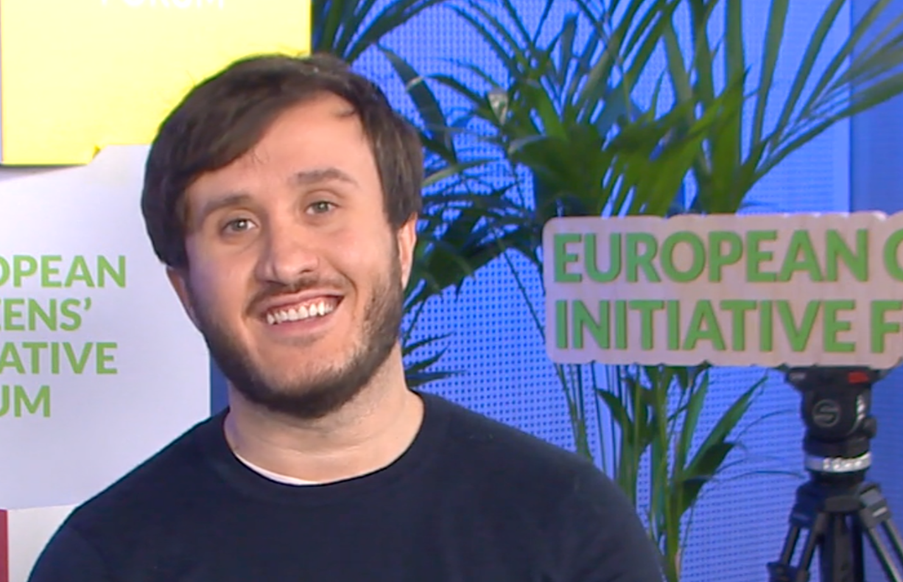
A good campaign starts with a solid argument and gets carried by political momentum. That’s the vision of Salvatore Ricci, a Brussels-based Italian activist behind the European Citizens Initiative ‘Stop Funding Russia’s War: Phase Out Harmful and Useless Russian Imports into the EU’.
As in May 2026 the ECI continues signature collection into its fourth month, we hear Salvatore’s advice for launching a legally thought-out, politically driven initiative: build your ECI around a concrete and timely issue, ground it in strong evidence and launch when the moment is right.
Step 1: Start from a concrete, evidence-based problem
Salvatore’s journey began last year when he started a new job in Brussels working on trade policy for a steel company. One of his tasks was analysing data on the EU’s steel trade, and what he found surprised him: despite cutting many economic links with Russia since its full-scale invasion of Ukraine, the EU was importing large amounts of steel slabs from Russia.
Crunching the data, Salvatore found that all this steel was being imported by one Russian company that still had access to European markets. But this was not an essential product. Currently, the steel market is over capacity, which means there is plenty of it available for import from other parts of the world.
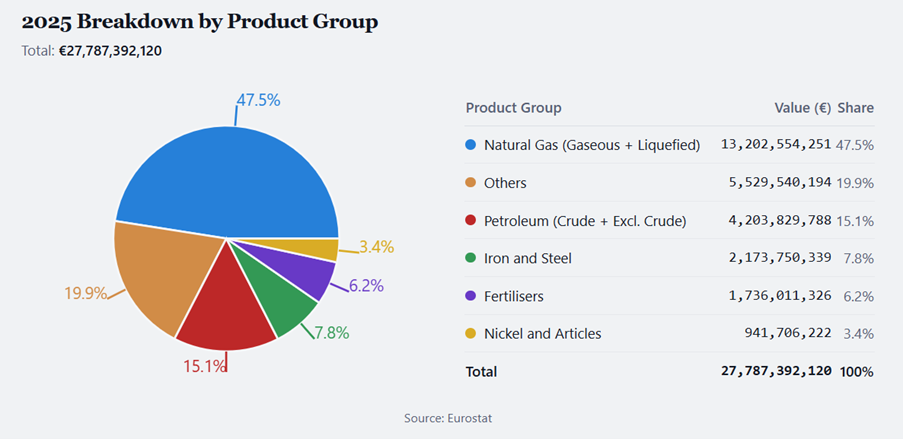
This got Salvatore thinking and with help from other activists he started looking into other sectors, finding other products imported from Russia for which ample alternatives exist, such as fertilisers, nickel and iron.
The group realised these billions being sent to Russia constitute a big gap in Europe’s attempts to freeze out Russia from its economy and limit its ability to finance the war, and they knew they had to act.
Next, they had to find a legal basis for proposing a ban, deciding to root it in the EU’s Common Commercial Policy under which Member States delegate the setting of import and export rules to the European Commission. This is important, because asking for action this way would allow the EU to adopt the policy through trade powers rather than through the regular sanctions mechanism, which requires unanimity among member states.
Once the Commission approved the initiative and its legal basis, the ECI took off the ground, with a clear campaign line: Stop Funding Russia's War Machine.
The lesson: Build your ECI around a specific, demonstrable problem with strong evidence behind it. Salvatore and his colleagues followed four steps: identifying the issue, gathering concrete evidence, determining how the EU could make it happen, and translating it into a digestible campaign line.
Read also: How to prepare an initiative for registration
Step 2: Connecting the campaign to political momentum
A few weeks after he started preparing the initiative, Salvatore came across a joint call by seven EU Member States asking for similar action to stop imports - but based on the sanctions’ regime. He read this as a sign that the political will is there, and that the time to get moving is now.
The goal for the ECI now is to send a clear message that there is popular support for new measures targeting Russia’s ability to finance the war in Ukraine. While some believe there is growing fatigue with the issue as the war continues into its fifth year, Salvatore wants to counter these perceptions and re-energise public engagement around the war.
And policymakers need to be re-energised too, Salvatore believes. “I came across policymakers on this topic before in my job, and I feel that they were a little bit detached from the reality. They were very technocratic,” he says.
The organisers decided to launch as soon as they got the Commission’s approval. While many ECIs plan extensively before launch, the group deliberately launched quickly, because any delay means billions more are flowing into the Russian economy.
This meant that signature collections opened without a clear campaign structure, which had some trade-offs. With the year-long clock already ticking, the organisers were still working on setting up a full campaign structure, reaching out to various organisations for support and coming up with a plan on how to get to 1 million signatures. To fill the gaps, in the first months the organisers focused on social media campaigning while discussing further action with potential supporters. By mid-May, they had gathered more than 13,000 signatures, with citizens in Sweden and Finland supporting the initiative most actively.
But despite a slow start, Salvatore is hopeful the campaign will collect 1 million signatures and continue into the next phase, in which engagement with policymakers will be crucial. The call by seven countries that propose similar trade restrictions suggest there is already political support for the idea. Salvatore says many other member states will be interested too. “Legally speaking, it can be done. Politically speaking, I think it can be done, and we will try to support it that way,” he says.
The lesson: if the initiative is urgent and political will is there, momentum may matter more than perfect campaign preparation.
Want to share your opinion? Leave a comment here or join our Discussion Forum
Need help with your initiative? Use the service Ask an expert to get advice

Contributors
Goda NaujokaitytėGoda Naujokaitytė is a freelance journalist specialising in European policy and writes about the European citizens’ initiative for ProMedia. Her work is informed by her experience in Brussels, both inside and outside the EU institutions, as well as time spent living in various European countries. She covers primarily EU digital, green and competitiveness policy, as well as research and innovation in the European Union.
The opinions expressed on the ECI Forum reflect solely the point of view of their authors and can in no way be taken to reflect the position of the European Commission or of the European Union.

Leave a comment