
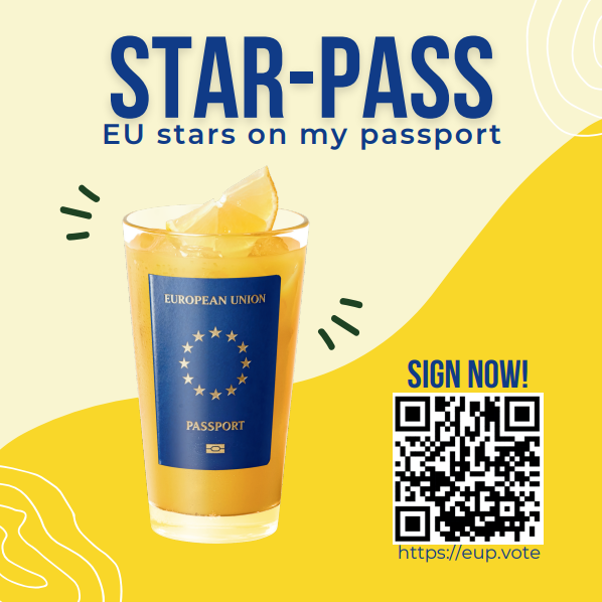
Volunteer-led European citizens’ initiatives may be grassroots, but their organisation and structure are often nothing short of a professional endeavour. This is how the ECI EU Stars On My Passport (STAR-PASS) has mobilised supporters across the EU and built a team.
For the organisers of the ECI, which seeks to give EU citizens the option of a common European passport cover, recruiting volunteers was the top item on the to-do list.
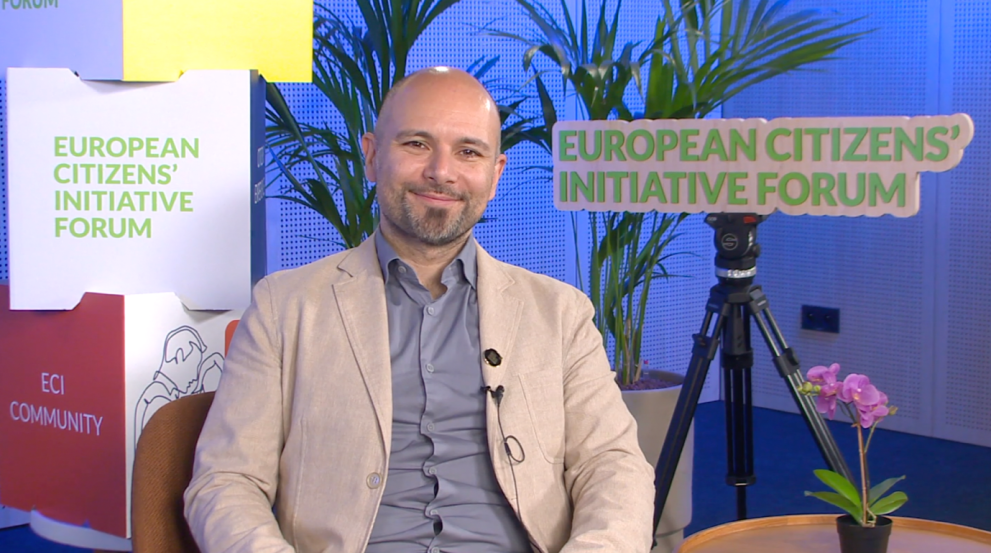
“The first thing we clarified was what are the critical things that can help us right now, and this was building a team,” the ECI’s substitute representative Davide Biasco tells the Forum.
Petru Ciudin, a member of the group of organisers who has joined as a volunteer, says he heard about the idea for an EU-wide passport through friends and immediately thought he wanted one himself. This inspired him to join the campaign and help promote an idea he was surprised no one had proposed before.
For him, the initiative is about promoting a joint European identity, an idea he feels passionate about as a Romanian.
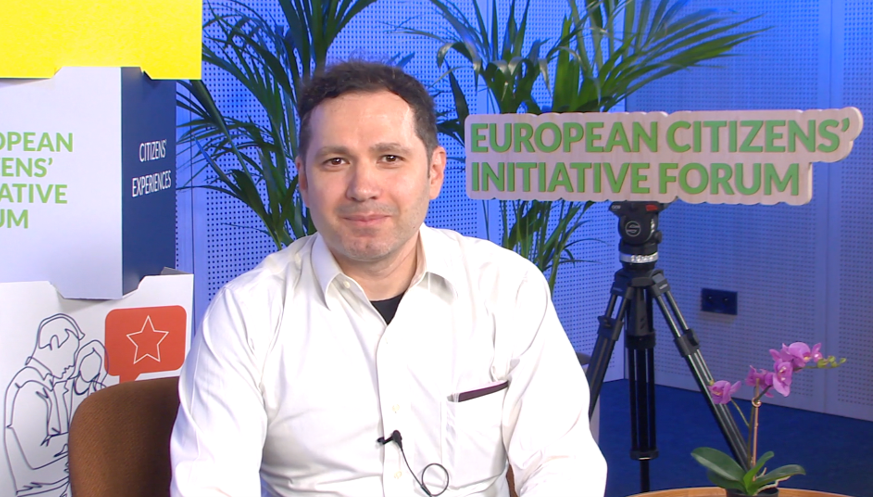
“We consider ourselves a massively pro-European country,” says Ciudin. But there’s also a practical aspect, he adds: “A European cover for my passport would help me feel more at ease when travelling both inside and outside the EU.”
Travel is also what inspired the original idea, which came from the ECI Representative Serban Alexandriuc. He has had plenty of unpleasant experiences crossing borders, when his Romanian passport was not treated equally to other EU passports. A clear EU-marked passport would help overcome these inconsistencies, the organisers believe.
“Some European passports are treated differently from others, that’s the reality”, says Biasco. “The idea is that this can give a sense of belonging to people who want to choose it. It gives us visibility when we’re outside the European Union. When we use our passport abroad, it shows we are members of the same large community.”
The message has resonated with many Europeans. Two months ahead of the launch of the signature collection phase, the ECI had already gathered a volunteer-led marketing team, responsible for the initiative’s messaging. Interest in volunteering time for the initiative has only grown since, with plenty of new members joining the ECI’s open WhatsApp group, Biasco reports.
A month after opening signature collection, the ECI had secured more than 13,000 signatures, still far from the one-million target, but an encouraging start for a volunteer-run campaign.
Volunteers at the heart of the action
Once on board, volunteers have been quick to take initiative. Two volunteers have drafted a communication plan for the ECI. They were recruited just weeks before the launch of the initiative, a day ahead of 9 May, celebrated as Europe Day.
The team has also prepared ample templates and materials that volunteers can use to reach out to media outlets, influencers, associations, politicians and others to ask them to promote the ECI. These are all publicly accessible in multiple languages on the ECI’s link page.
With the help of these resources, the volunteers have already secured support from the organisations, associations and platforms including the Good Lobby, EU Reports, Euractiv, Volt, the Young European Federalists and Other Europe.
Professional approach to volunteer recruitment
What is particularly striking is how professionally the initiative approaches volunteer recruitment. Rather than simply inviting supporters to help, the organisers have defined a range of specialised roles covering communications, content creation, community management, recruitment, branding and country-level outreach. Current openings include Country Communications Leads for individual Member States, Content Creators, Reddit Community Managers, a Talent Manager responsible for volunteer recruitment and onboarding, and a Brand Identity Designer. This suggests a campaign strategy that treats volunteers not merely as supporters, but as a distributed European campaign team, with clearly defined responsibilities and structures designed to scale across multiple countries, despite the initiative having no paid staff or external funding.
All this effort is coordinated through dedicated WhatsApp and Discord groups, both open for anyone to join.
Allowing anyone to join has also helped the organisers reach more countries, as some volunteers have spontaneously created country-specific WhatsApp groups to coordinate locally and spread the word. This has improved the ECI’s reach beyond the initial group of focus countries, and the core organisers are very happy to see it.
At first, the organisers, given the cross-border goal of the ECI, wanted to involve all the EU member states in the campaign. But with limited time and resources, they knew from the get-go that they would have to focus efforts. To best direct their resources, they had made an analysis of all the member states, taking into account population size, participation rates in online initiatives, how pro-European they are and minimum signature thresholds. “We built a small matrix and identified about a dozen countries we should prioritise,” Biasco says.
The big picture
But for the organisers, reaching more countries and supporters is not just about gathering 1 million signatures. They see the ECI as a tool for gathering momentum for an idea and getting it out in the public domain.
They have done their homework studying successful ECIs and learnt that viral ideas may have a bigger impact than complex ECIs that reach 1 million signatures but fail to secure political backing.
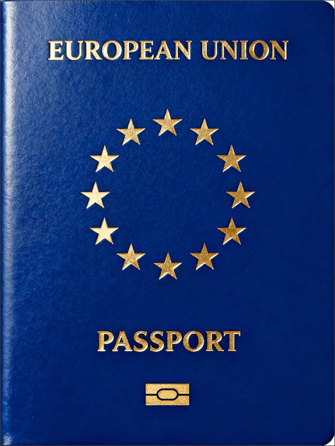
After all, for now, not all Europeans are sold on the idea of a united Europe and even fewer still may want to switch out their national passport for a common European one. For the organisers, the ECI is as much about starting a conversation on European identity and building support for blue passport as it is about reaching the one-million-signature threshold.
Read also:
Want to share your opinion? Leave a comment here or join our Discussion Forum

Contributors
Goda NaujokaitytėGoda Naujokaitytė is a freelance journalist specialising in European policy and writes about the European citizens’ initiative for ProMedia. Her work is informed by her experience in Brussels, both inside and outside the EU institutions, as well as time spent living in various European countries. She covers primarily EU digital, green and competitiveness policy, as well as research and innovation in the European Union.
The opinions expressed on the ECI Forum reflect solely the point of view of their authors and can in no way be taken to reflect the position of the European Commission or of the European Union.

Leave a comment