
What does succeeding with your European citizens’ initiative really mean?
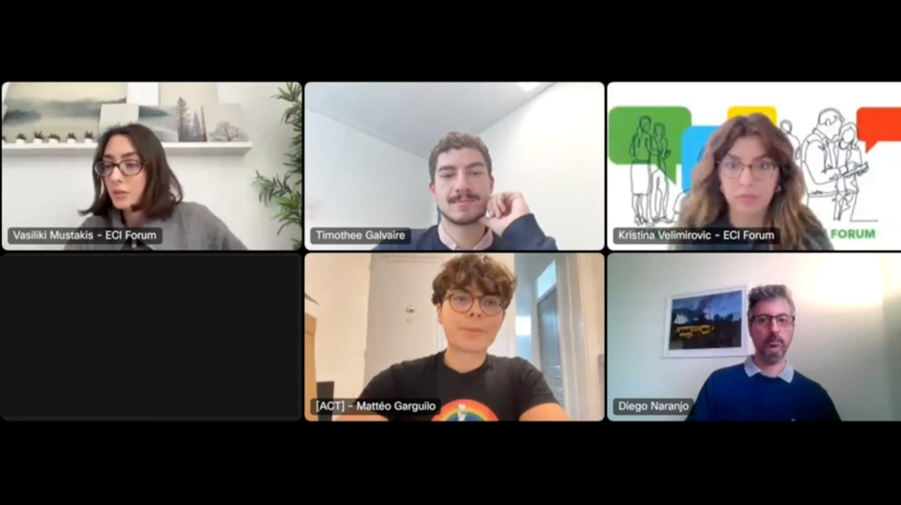
This feature draws directly on insights from the recent ECI Forum webinar “Shades of Success: Understanding the ECI Journey”, where three organisers shared what it really takes to collect one million signatures—or to make a difference without reaching that goal.
If you’re planning your own ECI, this is your insider’s guide to the real journey: from building a team and finding allies, to managing setbacks, mobilising communities, and turning small wins into lasting impact.
Getting the one million and charging ahead
First came Mattéo Garguilo, one of the young organisers behind the Ban on Conversion Practices in the European Union.
Their goal was straightforward but ambitious: to ban so-called “conversion therapies” across the EU, practices aimed at changing or suppressing someone’s sexual orientation or gender identity — recognised by the UN as a form of torture.
“We are an association without any funding… only students,” he began. “This means you can launch an ECI even if you have no means. Believe in yourself and keep fighting.”
Mattéo and his friends from Lyon’s ACT Against Conversion Therapy had no office, no staff, and no budget. For most of their one-year campaign, progress was painfully slow — only 250,000 signatures after 11 months. Then, six days before the deadline, everything changed.
By the final day, they had gathered 1.25 million signatures, reaching the national thresholds in more than seven Member states. The result: their proposal is heading to the European Commission, with a meeting to be organised with the Commissioner for Equality and a formal Parliament hearing expected in early 2026.
“Now comes the hard part — the lobbying, the meetings with the Commissioner, the hearing in the European Parliament,” Matteo said. “It’s scary, but that’s how you turn signatures into action.”
Changing the law without reaching the one million
Next came Diego Naranjo, who helped launch Reclaim Your Face — a civil-society initiative calling for a ban on biometric mass surveillance. The campaign argued that technologies like facial recognition threaten privacy and fundamental rights.
The initiative gathered 78,000 signatures, far below the official threshold, but its influence proved far greater. As EU institutions began drafting the Artificial Intelligence Act, the coalition’s proposals found their way into early legislative drafts.
Their work helped secure provisions limiting biometric surveillance in public spaces — a direct reflection of their advocacy.
Sometimes, the number on the signature counter doesn’t reflect the real impact. As Diego put it:
A lesson in advocacy and endurance
Finally came Timothée Galvert, organiser of Ending the Aviation Fuel Tax Exemption in Europe.
His ECI demanded an end to a long-standing tax privilege: kerosene for aviation remains untaxed in the EU, making flights cheaper than trains despite their higher emissions.
Launched during the 2019 European elections, Timothée’s team of students had just four months to prepare.
They eventually gathered 32,000 signatures — not enough to trigger a Commission response, but enough to create a cross-border conversation. The ECI sparked debates in media outlets across Europe and helped connect grassroots climate groups, train advocacy networks, and local air-pollution NGOs.
Today, many of those same campaigners continue to cooperate under new coalitions pushing for fair mobility taxation and green-transport subsidies at EU level.
The bigger picture
Each of these campaigns shows that success in a European citizens’ initiative has more than one face. It can mean policy change, public awareness, or simply a stronger network of people who will try again with better tools next time.
- Read Second time lucky: how ‘Stop Cruelty Stop Slaughter’ used past ECI experience to reach 1.325 million signatures
- See what you can achieve with the European citizens’ initiative – even without one million signatures
None of the organisers who spoke in this webinar followed the same path, yet they all learned to adapt — to measure progress not only in signatures, but in influence and experience. Their stories suggest that the real value of an ECI lies in what it teaches: how to frame an issue, find partners across borders, and stay resilient when results take longer than expected.
If you’re preparing your own initiative, these are lessons worth studying before you start. Explore the Forum’s guides and learning resources to see how others have built campaigns that made a difference, even without reaching the million. And if you’re unsure whether your idea fits EU competences, the Forum’s Ask an expert service can help you shape it into a proposal with real potential.
Because the next “shade of success” might be yours.
The opinions expressed on the ECI Forum reflect solely the point of view of their authors and can in no way be taken to reflect the position of the European Commission or of the European Union.

Leave a comment