About End the Cage Age
The “End the Cage Age“ is the 6th successful European Citizens’ Initiative, calling on the European Commission to propose an EU-wide ban of cages in animal farming. In the EU, more than 300 million farmed animals are kept in cages for most of their lives. Cages are cruel and unnecessary, as cage-free farming systems exist and are commercially viable. “End the Cage Age” succeeded in gathering support from 1,397,113 verified signatories with the minimum threshold reached in 18 Member States. The initiative was formally registered on 11 September 2018 and invited the Commission to propose legislation to prohibit the use of:
- cages for laying hens, rabbits, pullets, broiler breeders, layer breeders, quail, ducks and geese;
- farrowing crates for sows;
- sow stalls, where not already prohibited;
- individual calf pens, where not already prohibited.
Following submission of the initiative on 2 October 2020, the organisers formally met with the Vice President of the European Commission for Values and Transparency, Věra Jourová, and the Commissioner for Health and Food Safety, Stella Kyriakides, and later presented the initiative during a public hearing at the European Parliament (on 15 April 2021). In a plenary session on 10 June 2021, MEPs endorsed EU citizens’ call for a gradual end to cage farming and adopted the corresponding resolution with 558 votes in favour to 37 against, and 85 abstentions.
On 30 June 2021 the European Commission adopted its communication on this initiative. It spelled out proposed actions, namely: to table, by the end of 2023, a legislative proposal to phase out, and ultimately prohibit, the use of cage systems for all animals mentioned in the initiative. In parallel to the legislation and to facilitate a balanced and economically viable transition to cage-free farming, the Commission listed other supporting measures.
Initiative registered
11/09/2018
Start of signature collection
11/09/2018
Signature collection period closed
11/09/2019
Initiative validated by European Commission
02/10/2020
Initiative answered by the European Commission
30/06/2021
Tips from organisers
Citizens understand that cage farming does not belong in the 21st century.
The initiative focused on cages because they cause immense suffering and negatively impact animal welfare. “End the Cage Age” focused on one demand across the various species of farmed animals.
This initiative’s success was made possible by outreach with more than 170 organisations across Europe. Through sharing knowledge, experiences and resources the initiative became stronger.
The strategy behind End the Cage Age
Preparation
The organisers of the “End the Cage Age” initiative have substantial experience in promoting animal welfare and highlighting problems related to intensive animal farming. Soon after commencement of application of the European Citizens’ Initiative Regulation, they registered an initiative calling for an EU Directive on dairy cow welfare. However, the organisers withdrew this initiative soon after registration because of delays in delivery of the software system that would have been used to gather signatures. This first experience with the European Citizens’ Initiative process familiarised the team with the instrument and made them more aware of its potential. Knowing that the animal advocacy movement is widespread across the EU and that an increasing number of citizens want to see major improvements in the treatment of farmed animals, the organisers realised they needed to maximise support and increase their chances for legislative reform. The European Citizens’ Initiative, therefore, emerged as the appropriate tool to achieve this objective.
Careful planning was extremely important and drafting the initiative proposal required significant work. Preparations commenced a year in advance by defining the legal demand of the campaign and planning campaign and communication tools. In tandem with this, the organisers began identifying partners to support the campaign and ultimately recruited more than 170 organisations across the European Union. They also worked with the Animal Welfare Intergroup of the European Parliament and helped establish an MEP subgroup specifically working on ending cages in farming.
The organisers also wanted to ensure they had access to sufficient funding, feasible back-up plans and the capacity to proceed. It was also important to research and consider what this campaign wanted to tell European citizens and the Commission about the future of farming. During this process, the organisers reached out to citizens to discuss their ideas for the initiative: “We shaped our ideas with them. It wasn’t just coming from us, but we learned a lot from them.” After careful consideration, the cage: one of the most basic symbols of intensive animal farming, was chosen to guide the initiative. The initiative’s message as a whole was rooted in the existing reality, but it was essential that it was future focused, presented tangible alternatives and had positive elements.
Preparing an efficient communication strategy was vital for the organisers. It was important to define and understand the various target audiences, whether policy makers, the general public or the media. The style of the campaign message was adapted to ‘speak the language’ of the specific audience it was meant to reach at any given time.
Building an online presence was also a crucial part of the “End the Cage Age” communication strategy. The organisers built a website for themselves and also for several partners. In addition, it was important to create material to disseminate online and on social media to promote the initiative. According to the organisers, paid social media campaigns were helpful, but not a deciding factor in the campaign’s success. In addition to significant online focus, the campaign also relied on paper flyers and distributed them widely and in different languages (More information in this webinar, where “End the Cage Age” organiser Olga Kikou shares her insights on online campaigning).
When preparing a campaign management strategy, the organisers set milestones and clear target numbers for signatures in each Member State. They also prepared a detailed calendar outlining their tasks for each month of the campaign and for the post-collection period.
It was critical to the campaign’s success that all preparations and planning were completed prior to registration of the initiative (please note that today, under the new European Citizens’ Initiative rules, organisers have up to six months between registration and the start of the 12 months’ signature collection period. When the “End the Cage Age” initiative was launched, that was not the case).
Fundraising and resources
The organisers of "End the Cage Age" raised EUR 392,000.00 of support and funds from the Compassion in World Farming.
Sources of funding (€)

Note: Further information on End of Cage Age's support and funding is available on the dedicated Commission's webpage. Only contributions above €500 per sponsor are required to be reported.
Campaign strategy and signature collection plan
For the “End the Cage Age” campaign, there were often many levels of actions taking place concurrently. The organisers released investigative footage from farms using cages to increase public awareness around the issue and show the reality of the conditions in which many farmed animals have to live. Simultaneously, they worked with decision makers from the EU institutions, as well as different stakeholders such as scientists, businesses and organisations campaigning on the environment, health and farming. They also engaged with social media and tried to maintain a steady number of statements of support every month, while also formulating creative back up plans to use if support slowed down.
The partner organisations’ role was also essential. For the organisers, this was key to making partners feel committed to the cause and communicate that the initiative was as much their project as the originators. The organisers supported the network by creating and sharing material that they could use to best fit their needs and capacity. The organisers used newsletters and regular email updates as well as virtual calls to stay in touch with the network and ensure steady and continuous communication with their partners. Furthermore, many partners organised their own events and played a prominent and active role on social media targeting their own networks, localising and translating information and promotional materials.
From the outset, the “End the Cage Age” campaign decided to collect signatures from all EU countries, instead of focusing on just a few. Organisers managed to collect many signatures in countries where they had offices or representatives, as well as in countries where network partners had a strong presence. Launch events played an important role in the early stages of the campaign. These events were organised on national level in various Member States in cooperation with local partners, but also at the European Parliament.
Given the transnational nature of the instrument, an active presence in many countries was essential and the role of volunteers was pivotal for the campaign. During the campaign, several high-profile celebrities, such as actors Pamela Anderson and Ricky Gervais, endorsed “End the Cage Age”, which turned out to be very beneficial. Local celebrities also played an important role at grassroots level, as people were able to relate to them. The support of celebrities was invaluable, especially because of the multiplier effect their participation and support often creates.
Signature collection and verification process
The initiative organisers used an independent online collection system.
[While the organisers of End the Cage Afe used an independent online collection system, as of 1 January 2023, the Central Online Collection System is the only system that organisers can use to collect signatures online.]
Even though traditional campaigning was important and directly talking to people was a key part, it became clear to the organisers that most signatures would be collected online and not on paper.
In relation to the number of signatures collected, the organisers saw that there was a significant momentum at the beginning of the campaign, with many citizens signing the initiative. However, after a few months the numbers started to slow and the organisers had to come up with creative ways to increase the number of signatures again.
“End the Cage Age” used OpenECI, an online signature collection software that a number of other initiatives had already used in the past. The organisers’ decision to use OpenECI was largely based on its flexible user experience and the ability to collect users’ contact data (if they opt in) to send follow-up information.
Further information, tips and tricks on signature collection from Olga Kikou, “End the Cage Age” organiser, are available here.
Altogether, over the course of one year, 1,397,113 verified signatures were collected in 28 EU Member States and submitted on 2 October 2020.
The organisers believe that the phase following the signature collection was as important as the collection itself. They contacted the competent authorities in the Member States and ensured that all statements were delivered to them in a timely manner. This proved to be a complicated process that required gathering and sorting the printed statements by country, contacting officials in the countries and communicating with them to ensure their attention and prompt response. An additional challenge during this period was the need to prepare for the meeting with the European Commission and for the public hearing in the European Parliament, which are time-consuming activities. Finally, keeping the campaign alive and maintaining a high level of interest from citizens on the initiative was crucial during the submission period.
More information on the various stages of organising a European Citizens’ Initiative is available in this webinar. “End the Cage Age” organiser, Olga Kikou, shares how an organiser of a successful initiative experienced the different stages.
Number of statements of support collected by End the Cage Age per Member State
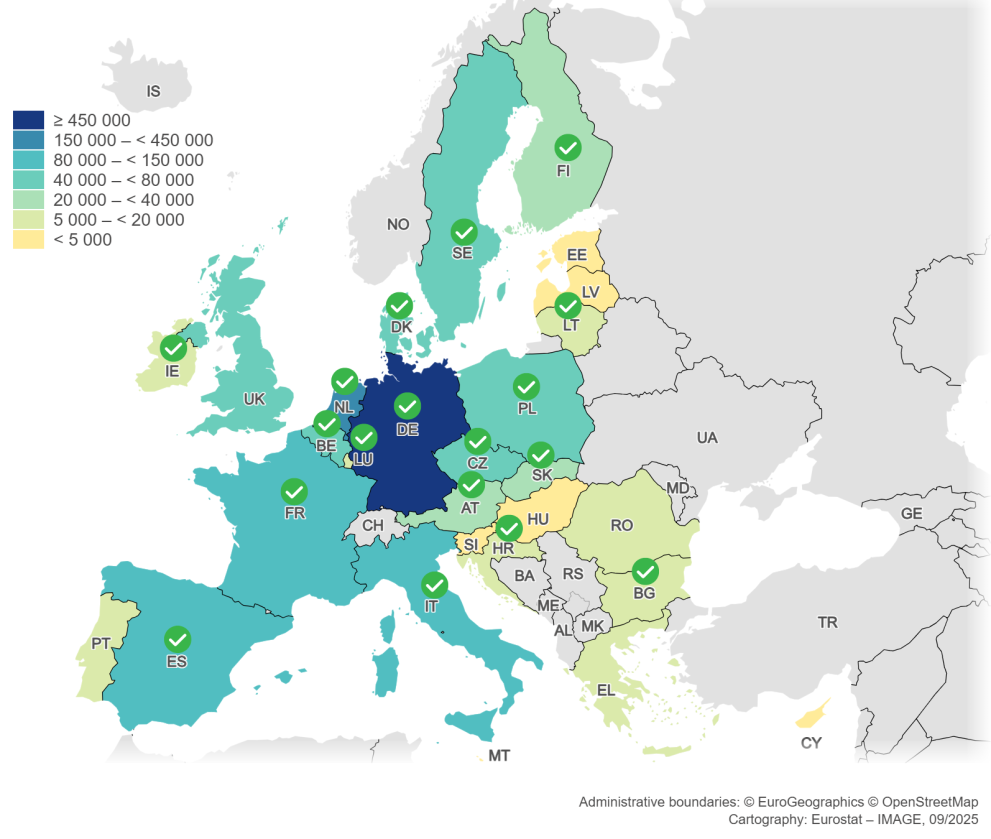
The check marks on the chart indicate the EU Member States where the minimum threshold of signatures required for supporting the initiative has been successfully met. End the Cage Age reached the minimum thresholds in 18 Member States. The full table with statements of support for End the Cage Age is available on the End the Cage Age initiative page in the ECI Register.
What made End the Cage Age a success?
It is important to be thoroughly prepared and avoid embarking on the process thinking it will be easy. It is not enough to have a good idea.
Put effort into building a strong network of volunteers and partner organisations to support the campaign. Planning and working with others is crucial. There will be many challenges before, during and after the collection phase.
Embark on an exchange with other organisers who have already launched a European citizens’ initiative, as well as stakeholders who are working on the problem you wish to change. A European Citizens’ Initiative only works through collaboration! Do your homework and learn as much as you can from organisers of other initiatives.
The process is not finished on the day the signature collection period ends. Preparations for meeting with the European Commission and for the public hearing in the European Parliament are time-consuming activities. Keeping the campaign alive is also crucial. Ensure that the issue does not disappear from public attention at this point.
The impact of the End the Cage Age
Formal submission and meetings with the Commission
On 30 October 2020, the organisers of “End the Cage Age” met Vice President of the European Commission for Values and Transparency, Věra Jourová and Commissioner for Health and Food Safety, Stella Kyriakides (see press release).
On 15 April 2021, the Committee on Agriculture and Rural Development of the European Parliament, in association with the Committee on Petitions, organised a public hearing on the initiative. During the hearing, “End the Cage Age” received broad support from MEPs across the political spectrum, in addition to positive comments made by Commissioners (see press release).
European Parliament public hearing
In the EP plenary session on 10 June 2021, Members agreed that EU legislation is needed and asked the Commission to come up with legislative proposals to phase out the use of cages in animal farming in the EU, possibly by as early as 2027, following an appropriate transition period and after a solid scientific impact assessment has been carried out. A resolution was adopted with 558 votes in favour to 37 against and 85 abstentions. MEPs further stressed that alternatives to cage farming exist and are being successfully implemented in several Member States. These alternative systems should be further improved and encouraged at Member State level, and EU legislation is needed to ensure a level-playing field for farmers across the European Union (see press release).
European Commission's formal response
After the debate at the European Parliament, the Commission presented, on 30 June 2021, its official response in the form of a Communication (see press release). In its response to “End the Cage Age”, the Commission committed to table, by the end of 2023, a legislative proposal to phase out, and finally prohibit, the use of cage systems for all animals mentioned in the initiative.
In parallel to the legislation and to facilitate a balanced and economically viable transition to cage-free farming, the Commission listed the following actions:
- Seek supporting measures in key related policy areas, such as trade and research and innovation.
- Since an end to the use of cages requires changes to current farming systems consider the socio-economic and environmental implications of the measures to be taken in an impact assessment to be completed before the end of 2022.
- Assess the feasibility of working towards the proposed legislation entering into force from 2027.
Follow up
See the Commission’s follow-up to this initiative
In addition to the formal impact of “End the Cage Age”, it is crucial to also shed light on the Initiative’s impact within the European Parliament. Most importantly, the organisers actively worked with the Animal Welfare Intergroup of the Parliament and helped to establish an MEP subgroup specifically working on ending cages in farming.

The opinions expressed on the ECI Forum reflect solely the point of view of their authors and can in no way be taken to reflect the position of the European Commission or of the European Union.